Shaun McDonald's Blog

My Random Ramblings


September 2010
M T W T F S S
« Aug    
 12345
6789101112
13141516171819
20212223242526
27282930  

My Most Recent Flickr Photos

www.flickr.com
smsm1's items Go to smsm1's photostream

Random Flickr Photos

www.flickr.com
smsm1's items Go to smsm1's photostream
  • With the English bank holiday weekend (Scotland has the August bank holiday on the first Monday instead of the last), I thought that I would go for one of my longer cycle rides and see if I could beat my previous record of 150 miles. On the Saturday morning I packed the 4.5 litre of water, home made pasta, chocolate and extra clothing layers into my panniers. I finally got going at 1pm, which was a lot later than I was expecting.

    The first part of my journey was heading north to the River Thames on the Waterlink Way/National Cycle Route 21. Then I followed the Thames to the Woolwich ferry using the NCN4 and 1. I decided to add a little extra adventure to my journey by crossing the River Thames a couple of times. First using the Woolwich Ferry to get to the North bank, which is free. Then following a part of the new Cycle SuperHighway 3, which is a rebranding of the previous cycle path that it runs along, to head east towards my next crossing. To get back to the South bank of the Thames, I used the Dartford crossing. You can’t cycle over, however a free pickup truck service is provided to take cyclist and bike over to the other side.

    After a nice chat about traffic and cycling with the traffic officer who took me across, I then re-joined the National Cycle Route 1 most of the way to Whitstable. I decided to follow a straighter new cycle route from just before Gravesend to Strood, which is part of the old A2 prior to it being upgraded.

    Shortly after Sittingbourne while following the NCN1, I seen on the right hand side of the road a car with the two door windows smashed a couple of people and another vehicle, which looked rather unusual. I continued further up the road until I was out of sight, as I didn’t know how they would react and then reported the car break-in to the police via a 999 call. As I didn’t know how to describe my current location well, thus I took a photo of the screen on my phone (which ended up against my face while talking thus unable to look at the screen) with the latitude and longitude, and gave the lat/lon to the operator, which worked. On Sunday afternoon I got a phone call from the police following up with some clarifications to the useful evidence. They were pleased that I had phoned in the incident as a witness as most people would have just turned a blind eye.

    A bit further down the road I stopped to eat some of my pasta, and suddenly some dark rain clouds came over and the heavens opened. Luckily it was just a fairly short shower and I had managed to find a bit of shelter for it to pass. It did worry me a bit as to how much more rain there would be for the rest of my journey. Luckily once that cloud passed it was clear for the rest of my journey.

    From Whitstable I followed the coast, much of which was on the path or promenades that runs along the edge of the sea. As I was getting into Ramsgate at about 2 am after 107 miles, I was getting too tired to be able to continue the rest of the night further round the coast safely, so I found a nice bench and shelter overlooking the sea to put my head down for a few hours. Luckily I had a towel with me that I was able to use as a pillow.

    Shortly after 5am I set off again slightly refreshed with the first signs of dawn. The route of the NCN1 down to Deal is quite nice. After Deal however it turns inland a little and into a very long climb that seems to just go on forever. It was nice to be able to get to the top and see the nice view across the English Channel. After a little decent there is the White Cliffs of Dover National Trust site, which has a nice view overlooking Dover ferry port. (Yeah, I’m sure you already know that I quite like travelling by ferry from time to time.)

    From there I headed down the short and steep downhill into Dover, the downhill was over way too quick considering the amount of uphill. I then took the train home, going the full length of the straight track from Ashford to Redhill (with a change at Tonbridge). The reason I mention it, is because it does look quite strange or unusual at lower zooms on a map, when there generally is more curves in rail lines.

    On the Sunday late afternoon/evening I took a nice 5 hour nap to catch up my sleep, before getting up for a few hours to catch up on a few things before heading back to bed for a full nights sleep.

    In total it was 133 miles over 20 hours, which is my second longest cycle in one go. The Dunwich Dynamo was 127 miles including the ride to the start. At some point in the future I want to ride from Dover anti-clockwise round the coast, particularly to try hill out of Dover and the long downhill into Deal. I’d also like to do Dover-Brighton via the NCN2.

    2 Comments
  • You may remember some of my tweets from the end of last year from an accident on my way home from work.

    I was cycling past Peckham Rye Park along the London Cycle Route 22 as I was usually doing, a motorist decided to come out of a side road even so he didn’t have priority and had plenty of time to stop rather than me ending up going over his bonnet. Luckily the people in the car behind me stopped and helped, including calling the police and ambulance, unlike the driver of the car that I had the collision with who drove off instead. He did come back to see if I was ok, but needed convincing from the paramedics to stay to talk to the police, who hadn’t quite yet arrived.

    I was taken to hospital as a precaution after giving the police a statement while lying on the bed with my head strapped in position. The police took my bicycle to the police station for safe keeping until I was able to pick it up. It turned out that I only had a few bruises, grazes and some shock, so was discharged and took the bus home.

    A day later I picked up my bike from Peckham Police station. At this point I found that the front wheel was a little buckled. Thankfully due having a hub brake rather than a rim brake I was still able to ride the bike safely to work and back home. It took 3 weeks to get a replacement front wheel for just short of £100. The train travel also cost an extra £100 that I wouldn’t have have spent otherwise. It was quite nice as the Oyster Pay As You Go had come in just after the accident and turned out to be a bit cheaper than a travelcard based on my specific travel pattern.

    After a couple of months I was sent a witness form to fill in, which I filled in and sent off:

    Yesterday I got a letter from the Metropolitan Police stating that the court proceedings with incident were completed last week. The result was the driver being convicted of driving without due care and attention with a £100 fine pus 7 penalty points.

    It’s good to see that the driver has been given some punishment for not being careful enough with his driving, rather than it being ignored by the police as I’ve heard has happen on many occasions in the past.

    No Comments
  • Last Saturday I took a train from Selhurst to Milton Keynes and started cycling back home. (At the moment you can get 15% off off-peak Southern tickets when you buy them at least 2 hours before travel, online.) I’d been thinking about doing that cycle since the Milton Keynes Mapping Party back in May last year.

    The first part across Milton Keynes to the Grand Union Canal, and then down to Leighton Buzzard went fairly well as the towpath is paved and some of it is part of the National Cycle Route 6. South of Leighton Buzzard however, the towpath turned to grass and for some of it mud. There were patches where it was paved nicely. There was one point the mud had got so bad I had to stop to clean the bike.

    These bird didn't want to let anyone past on the pathHeading through Berkhamstead there were some birds that  really didn’t like anyone going along their path, so had to hop off the bike and walk around them.

    Past the M25, and almost into Watford and I find another pile of mud in the path, so I stop to take a look at TrackMyJourney’s map viewer to see if there is an alternative route that may be better. Via the help of the OpenCycleMap (from within TMJ), I seen that there was the National Cycle Network Route 61, that hopefully would have been less muddy. About to move off and notice I had a puncture. So instead of trying to fix in the dark, with a muddy bike to hinder things, I decided the best option was to push the bike to Watford Junction station to get the train home and deal with the puncture once the mud had dried a bit, thus the mud would flake off.

    Also on the way to the station pushing the bike I manage to map a couple of missing street names, post boxes, benches, bike parking and found a street name that was mis typed into OSM.

    After the first attempt, I found that I had a slow puncture. It was another puncture elsewhere in the tube rather than the repair failing. It was a total of just shy of 40 miles, which is about half of the distance I was expecting to do. Considering that I’ve been doing very little cycling at the start of this year due to the bike being serviced from the accident at the end of last year, and the not so great weather, it’s not too bad. I suppose I’ll have to just postpone my annual maddly long first long cycle of the year until March. I also got a bunch of nice photos to add to the CycleStreets Photo Map, and test a new method that makes it faster to import photos from Flickr. This will mean that there will be photos of the route, when someone plans a journey that takes part of the route that I took.

    No Comments
  • At the start of October I took a week’s holiday up north in Dumfries in the run up to the Dumfries Mapping Party. It was a great week of mostly cycling, sightseeing and ended with a mapping party, held in the local leisure centre, DG One, which has some council meeting rooms.

    Heading out I was waiting on the Royal Mail delivering some OpenStreetMap reflective vests, which were supposed to have been delivered a few days earlier, though unreliable mail delivery is one downside of strike action. It meant that I had to delay my departure from home, thankfully I had bought the flexible train tickets from London to Dumfries, rather than the advance fares where you can’t change the train your travelling on and were only a couple of pounds cheaper when I was purchasing my tickets.

    The original trains that I had planned to get had a short, reasonable delay between them, however the train I ended up getting from London meant that there was over an hour wait in Carlisle. I couldn’t be bothered waiting, so I decided to set off towards Dumfries following the National Cycle Network Route 7, which at the time was only mapped to the edge of Carlisle. When I crossed the border, I checked the train times from Gretna Green on my phone and realised that the train that I would have got from Carlisle was due in about the time it would take me to get to the station. Sure enough I had a minute or two to wait on the platform before the train (with space for six bike at one end of the train, yeah ScotRail do know how to transport bikes unlike some other train companies I can think of) appeared. Later on in the week I completed the rest of the NCN7 from South of Dumfries to Gretna Green which hadn’t already been added to OpenStreetMap.

    Cycle track from my week in Dumfries

    Cycle track from my week in Dumfries

    I’ve had a little play with the Party Render scripts to produce the lovely image on the left. I customised the place names that were shown a bit to make it clearer.

    On the Wednesday meeting up with the local OSM contact (who goes by the name disgruntled, or known in the real world as Sally) for the first time at the Wednesday Wheelers meetup. It was quite interesting to see and hear the older generation happily cycling 10-30 miles for their regular weekly meetup. I felt quite at home considering my normal commute (well at the time) was 8-10 miles in each direction, and most people I speak to are surprised at the distance I cycle each day.

    Then on the Thursday I took a rather long ride over the hills of Ae and added the lcn 10 from Dumfries to Moffat. Sally had already mapped the first section of the route, which was a really nice cycle track, which had been converted from an old railway line. It was fairly flat until I got to Ae, where there is the Forest of Ae mountain bike trails, with some really steep hills that I wasn’t expecting. Thankfully just before the climb, and in time for a late lunch there was a nice little cafe, with a bike shop in the same building. Heading over the hills there were some really pretty views. It was also nice being in the middle of nowhere and only being able to hear some birdsong, and the light breeze in the trees. Once I hit the downhill, I found it pretty scary, as I wasn’t used to going down such a long hill with that style of track and occasional cattle grids.

    P1030991 P1030999 P1040021 P1040041 P1040057 P1040059

    On my return I took an earlier, but late running, train to Carlisle and cycled round Carlisle to get a bunch of it mapped.

    I was really impressed with the way that Sally had managed to write and get published an article in the local paper. She’s also been a great local contact and mapper. Dumfries council organised the nice venue, with the event being part of the Smarter Choices, Smarter Places programme in Scotland.

    I’ve been uploading the photos I’ve taken to Flickr in various sets. Then importing them into CycleStreets, so that they will appear in the route listings when you plan a route in the Dumfires area.

    1 Comment
  • Last Sunday (30/8/09) Simon Hewison and myself took the first train from London Paddington to Bristol at the fairly early time of 8am considering that we had to cycle across London first. We had purchased advanced fare tickets which were about a third of the price of the walk up fares.

    Full trace of the route

    Total distance for the main part of the route was about 80 miles. I also cycled just over 10 miles in each direction to and from London Paddington. I was originally planning to continue into the M25 and get a train from there or even continue through the night home. However the weather was very overcast and damp, and we were covering a greater distance than originally anticipated due to taking a bendy route and sometimes missing the directions signs for the National Cycle Network Route 4 and having to backtrack. We avoided mapping so that we could get a much greater distance. There were some roads that weren’t in OSM, and we found that the NCN 4 had been re-routed with part of the original route being renumbered.

    Here’s some photos of the day:

    P1010805This appears to be a variant of the Sustrans signposts, specific to the Bristol – Bath cyclepath on an old railway line.

    P1010834Here was the big staircase of locks that we cycled past.

    P1010845 Having the current OSM data on my phone means that I made Simon rather curious as to what the junction at the end of the road was. There was a sign stating that there was a roundabout, however there was just a simple T-junction in OSM. He raced off and caught a trace. I had been taking various photos of other little bits of data to add to OSM.

    P1010854There were several roads that we went along where there were signs that stated you were on a “quiet lane”. Do these have any special status?

    P1010862

    There was a bit of a problem of knowing the way at this junction until Simon beat the foliage down so that the ncn4 direction sign was visible.

    P1010879 When we arrived in the aptly named Hungerford, it was time for dinner so we found a hotel restaurant and collected the postcode and a couple of other POIs in passing, such as the bike parking in the centre of the village.

    2 Comments
  • Even in this day and age, the roads the general public cycle on are riddled with potholes, speed humps falling over themselves, or general unevenness around man hole covers and drains. I’m fed up with having to look at the road in front of me for these bicycle damaging unevenness and potholes instead of at the surrounding traffic, which to be honest is more important.

    There is already a service in the UK for reporting these defects to the local council, called FixMyStreet. There is even have an iPhone app for reporting problems while on the ground. However I felt that not enough people knew about FixMyStreet, and even fewer were reporting problems. So I decided to come up with a way to automate these reports to the local councils even further.

    I believed that these uneven roads could be crowd sourced through recording a GPS track, and a storage of seismograph by using the accelerometer in the iPhone or iPod Touch. These tracks are merged together and tied to the road network automagically, now that there are enough tracks in the system, analysis is running constantly to find places where many people regularly have a high vibration, when flying over a speed hump, or just about halted as though you have hit the kerb straight on by finding a conspicuous pot hole in the middle of a bus lane, about one bus length away from a sunken drain.

    Some of the crowd sourcing community have taken this a step further and provide a video stream of the whole cycle ride, which again is synced up with the GPS trace, and used as evidence of poor quality road surface. The whole sync process is done automagically after you upload. It is even more accurate if you up load a photo of the time on the GPS and the seismometer.

    OpenStreetMap is now using this data to enter all the traffic calming, in a few months time the Crap-O-Surface Detector service will start automatically suggesting places where there are speed humps, and giving the appropriate, err smoothness tag* for every road.

    CycleStreets have found the data to be so good, that they have decided to postpone implementing traffic lights, specific routes, fixing the OSM to Cycle Streets types, and of course hill avoidance, in favour of using the data from the Crap-O-Surface Detector service. Don’t worry, all the other items are still on the todo list.

    So I’m please to announce that the Crap-O-Surface Detector is now out of the private pre-Alpha, and today entering the Beta stage in the software cycle, please head over to Crap-O-SurfaceDetector.com to see how you can participate, while watching more roadworks in the places that really, really need them. Once the roadworks are gone, you should (if the council contractor has been doing their job properly) see a marked improvement in the road surface.

    2 Comments
  • Yesterday (Saturday) I done one of my rather large February cycles. I didn’t go quite as far as last year’s 150 mile cycle, though I still done more than the 70-100 miles I was anticipating doing. In total it was about 115 miles (the last 4 miles were from Bromley South station home). The total journey time to Dover was about 12 hours. When I set out I decided that my camera would stay at the bottom of the pannier, otherwise I’d spend too much time taking photos, rather than getting somewhere.

    The route I took was heading out fairly direct to Faversham, via Bromley, Swanley, unmapped Cobham, Rchester, Rainham, and Sittingbourne. After Faversham I headed to the coast all the way round to Ramsgate, where I hit the A256, and then the A2 to race down the road to Dover to get the last direct train back to Bromley South.

    I hadn’t prepared quite enough with my GPS tracking. For those who don’t know I use a private beta of TrackMyJourney on my Sony Ericsson K850i with a bluetooth GPS for most of my location logging and mapping. I know that my main 5Hz bluetooth GPS lasts only about 8 hours, so I got my older, less reliable on cities, GPS partially charged, but not enough to last until the phone ran out of power. After I ran out of power I was using a fast direct route, so it was easy to get the route’s distance using CloudMade’s routing. I did have a GT-11 GPS as a backup, however the 16MB card is too small for my extravagant cycle journeys, though the battery did last for the whole journey. Ah well, couple of lessons learnt.

    It’s been great to be able to have live re-routing over the web,  constantly updating my ETA, and the ability download map tiles live, thus able to have the cycle map wherever I am within mobile phone signal range.

    I did find a part of the NCN1 to the east of Sittingbourne, where the route took you into a pile of trash at the side of a traveller camp, with no further signage.

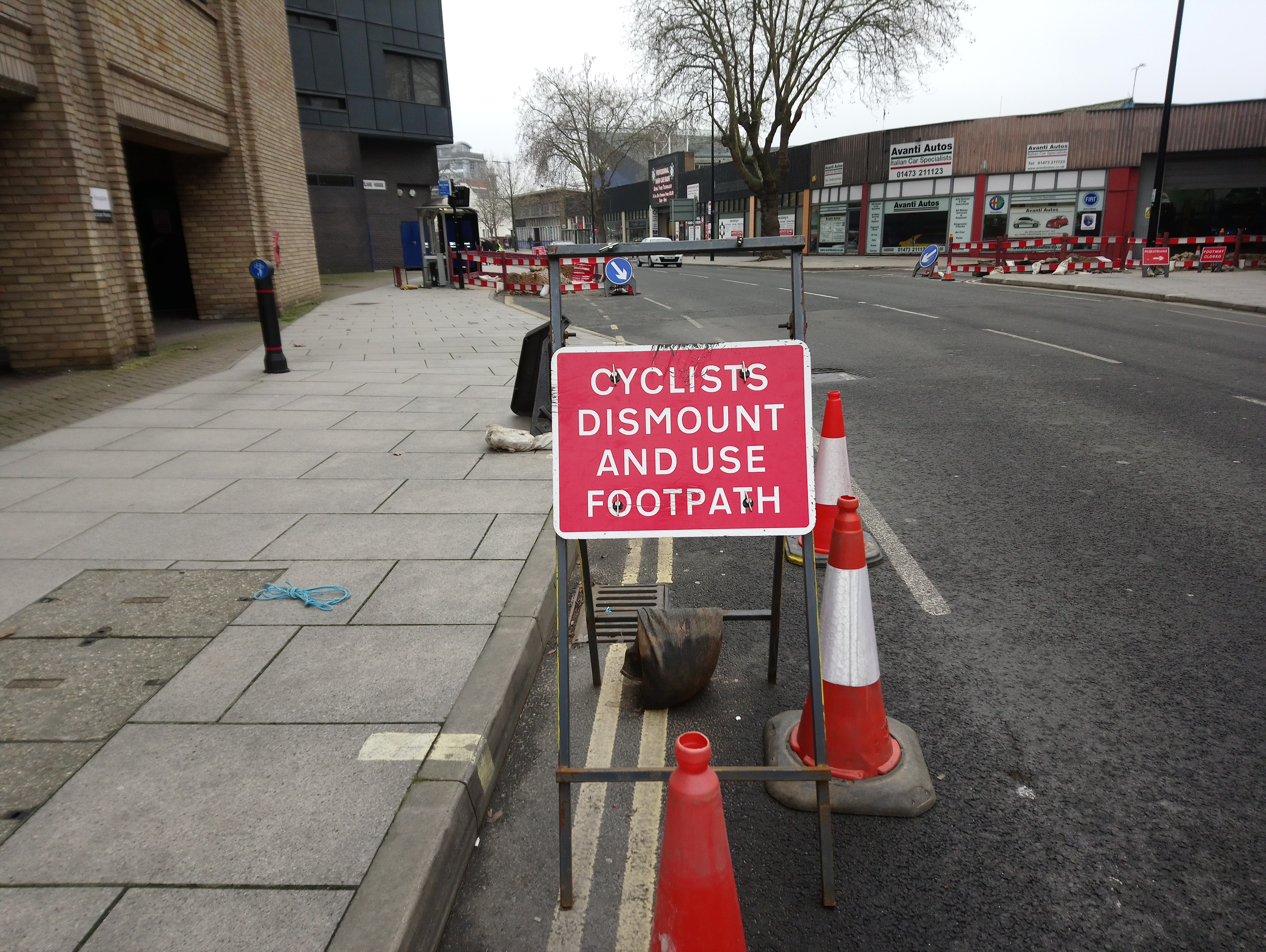
    I really enjoyed cycling along the coast, I found it quite rare to be able to go for so far that close to the coast, because usually you have private properties next to the coast for much more of the coastline. There was one place where I saw a sign telling cyclists to slow down and give way, where you would normally just get the irritating and unnecessary ”cyclists dismount” sign. I really should have taken a photo of it, but then would I have had to go via London Bridge?

    In the future I’ll hopefully get around to cycling from Margate to Folkstone at a more leisurely pace to be able to take in the scenery.

    3 Comments
  • With the extra eating over Christmas, I’ve started out on my (evening) cycling again. On the 1st of January I headed out East and got to Rochester before getting on the train home. On the way near to Ebbsfleet International I found a rather interesting sign that I just had to take a picture of.

    P1080076.JPG

    After uploading it to Flickr, I check that I had geocoded it right, by looking at the map on Yahoo. I got very confused. It seems that Flickr need to start using OpenStreetMap data for London. Yahoo don’t that the new Channel Tunnel Rail link and some of the new roads around Ebbsfleet International, though they do have the location of Ebbsfleet International. Compare Yahoo with OpenStreetMap.

    UPDATE: Looking further it seems that Flickr are using older map tiles compared to Yahoo.com, but appear to be the same tiles as used in Yahoo UK

    END UPDATE

    On the way I was testing out some routing using osm data, and found a few data bugs. One very important one being a primary road that goes through a tunnel, which doesn’t allow cyclist, pedestrians, nor horse drawn carriages, hence routing cyclists through it shouldn’t be done.

    On the 2nd day of the year, I took the train down to Caterham, which is just inside the M25, and then cycled back up mostly using the NCN21. On passing through New Addington, I got a little mapping done on the way, mostly new roads that are completely missing from OSM, there is a lot of mapping required down there. Anyone up for a mapping party?

    3 Comments
  • On Friday I headed along to this Months Critical Mass. It was very strange that the Police weren’t there at all to do the corking of the junctions, and hold back any frustrated drivers. The two usual off-duty bike paramedics were there. It took a while for the mass to get used to the idea of corking the traffic themselves. There was a few times when some drivers tried to have a run at some of the cyclists, which was quite frightening. These possibly would have been less likely to happen with the bike police there. The key to preventing the drivers from being annoyed is to keep the whole ride moving all the time.

    After Buckingham Palace the ride managed split in two, with both halves meeting up later. At one point we did bump into a bunch of organised roller skaters.

    As the sun is setting around the time the ride starts off, so it becomes more difficult to get good photos, particularly with most people wearing reflective clothing.

    Overall it turned out to be a good night without any major incident.

    P1060619.JPG P1060611.JPG P1060613.JPG P1060608.JPG

    No Comments
  • Last weekend (22-25 August) I went over to Dublin for the Dragheda Mapping Party. I took the train and ferry over, instead of flying, so that I could take my bike. I did get some coding and catching up done on the train and ferry. I found it interesting that Virgin Trains run electric to Crewe, then attach a diesel locomotive on the front to continue into Holyhead. I also found that Virgin Trains now have “enhanced mobile reception” on their trains. I did have to give up trying to use the GPS as Virgins don’t have enhanced gps reception.

    I was staying in Dublin and travelling up to Dragheda each day. There has been some considerable progress in the area over the weekend, going from only the main roads mapped to most of the town being mapped by the end of the weekend.

    P1050090.JPG

    There was some pre-event publicity in a local paper. However the original press release that went out somehow got completely mis-interpreted.

    On the Saturday there was a lot of overlap between the mappers, so we got all the traces and photos loaded on to Dermot McNally’s Mac, and done the editing all at once. It prevented people adding the same roads multiple times.

    P1050287.JPGOn the Sunday morning I was picked up by Dermot and we done some car mapping on the way to the venue. At one point we had to get out and hold the vegetation back so that we could take a picture of the street sign.

    On the way back I hit the start of the 17 day closure of the west coast mainline for rail works, so had to change trains and get lost going from Birmingham New Street to Birmingham Moor Street. I did manage to get a trace all the way back, and map a few streets in Holyhead. Probably should have stayed in Holyhead to do some more mapping and take a later train.

    No Comments